Chicago Startup’s Smartphone Tech Could Make Every Phone a Gunshot Detector
Liberty Check
- Chicago-based SplitSec transforms ordinary smartphones into gunshot detection sensors without government-mandated hardware installations
- Privacy-first design keeps audio analysis on individual devices, not centralized servers — a stark contrast to government surveillance models
- Community-powered alerts empower citizens to protect themselves rather than waiting for official response
A Chicago-based startup is testing technology that could turn every smartphone into a gunshot detector, putting personal safety back in the hands of citizens. The innovation comes nearly two years after the city abandoned its costly contract with SoundThinking, the company formerly known as ShotSpotter.
SplitSec, founded in Chicago in 2025, has developed an app that uses the microphones already built into Android phones to detect gunfire. The approach eliminates the need for government-installed fixed sensors scattered across neighborhoods.
“As I observed events around us, one of the things that was striking is any time there is a gunfire incident, people are unaware, and they stand there for several minutes not knowing what happened. And so the idea was how can we make people aware sooner?”
SplitSec founder and CEO Sri Deivasigamani told Fox News Digital the company centered its thinking on personal safety and awareness, using technology people already carry every day.
Two no-cost trials are currently underway in Chicago’s 21st and 42nd wards, with discussions about expanding to three additional wards. Users participating in the trials have provided valuable feedback that’s helping the company refine its technology.
Some phones showed a high degree of false positives due to sensitive microphones, while others experienced battery drainage issues that engineers are now addressing. But the technology has already proven itself in real-world conditions.
“For some users, on July 27 and 28, the app actually detected gunshots and the user confirmed that they heard gunshots. So, it was an important moment for us.”
While Chicago previously relied on SoundThinking’s fixed sensors, SplitSec harnesses the computing power already in smartphones. Advances in smartphone technology have made such an application possible, according to Deivasigamani.
“We, you know, could not do this a few years ago, but these days, smartphones are AI-enabled. They have a lot of computing power. So, we designed and built an AI model that runs entirely on your phone. And just like your phone can wake up when you say, ‘Hey, Siri’, or ‘Hey, Google’, we have designed our app to wake up only on gunshot sounds.”
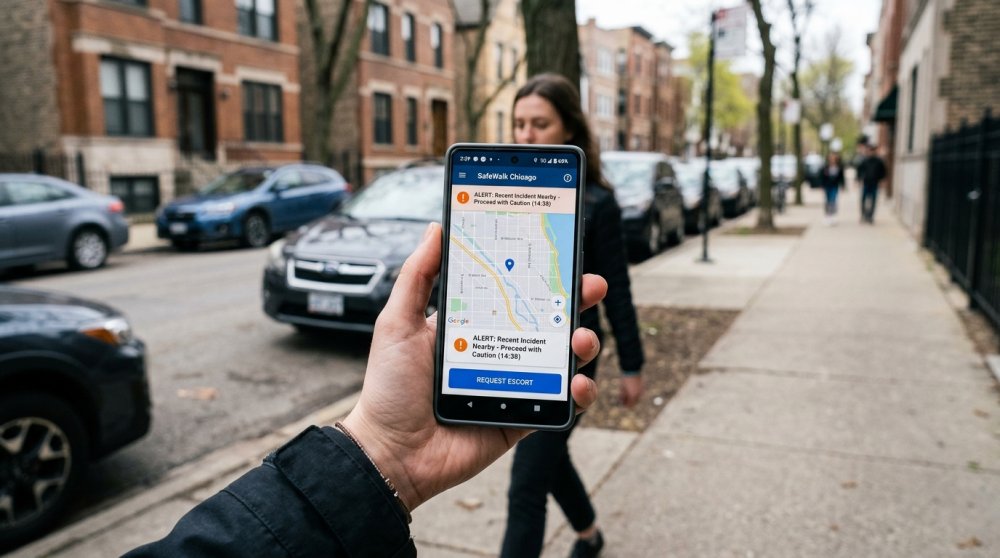
The system works similarly to Waze, relying not just on automated detection but on user confirmation to create a community-powered network. When the app detects what sounds like gunfire, it prompts the user to confirm whether shots were actually fired.
If confirmed, SplitSec distributes alerts to people within a one-mile radius. When two or more users confirm the same gunshots, the company can triangulate the shooter’s location, helping people run away from danger rather than toward it.
“Many shootings have happened where people are actually running towards gunfire because they really quite honestly don’t know where it’s coming from.”
Chicago ended its contract with SoundThinking in 2024 after political battles over cost and effectiveness left the Chicago Police Department without gunshot alerts from sensors across the city. SplitSec is not currently working with CPD, and its alerts are designed for users, not law enforcement.
However, Deivasigamani said that if the company were to partner with CPD or Chicago’s Office of Emergency Management and Communications, it could provide the same anonymously reported gunfire map that users see.
Privacy concerns have naturally arisen around the use of residents’ smartphones to detect gunfire. But Deivasigamani emphasized that audio analysis takes place entirely on users’ devices, not on company servers.
Audio clips are only sent to SplitSec if a user reports a false positive and agrees to share the recording. Those clips are then used to train the model on different sounds to improve accuracy.
“We really believe such an app needs to earn people’s trust and needs to be built in such a way that it protects privacy.”
Americans deserve better than waiting helplessly for help to arrive.