Socialist Senator Pushes INSANE Bill That Hands AI Dominance to China
Liberty Check
- Bernie Sanders and progressive House Democrat want criminal penalties and “corporate death penalties” for American AI developers — while China and Russia race ahead unchecked
- The Ban Artificial Superintelligence Act would create a massive new Cabinet-level federal agency with power to physically destroy U.S. tech infrastructure
- National security experts warn this surrender of American innovation leadership carries “serious economic and national security costs”
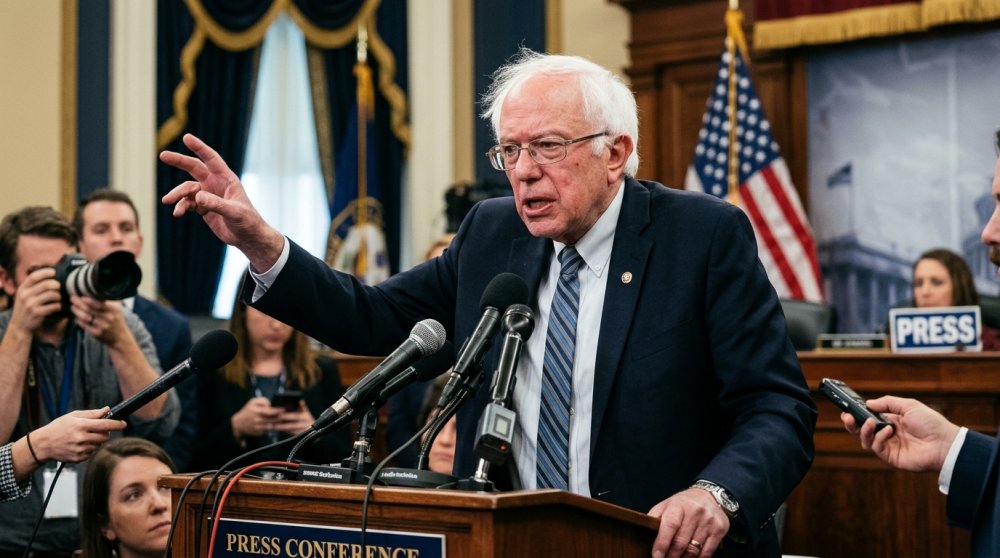
Sen. Bernie Sanders and Rep. Greg Casar just introduced legislation that reads like a gift-wrapped present to Beijing and Moscow. Their so-called Ban Artificial Superintelligence Act would slap American AI developers with up to 20 years in prison and impose what they’re calling a “corporate death penalty” on U.S. tech companies.
The timing couldn’t be worse. While China aggressively expands its AI capabilities without restraint, Sanders wants to kneecap American innovation with criminal penalties modeled after laws governing nuclear weapons development.
The Vermont socialist’s bill would temporarily halt advanced AI development and establish yet another Cabinet-level federal bureaucracy with sweeping authority to oversee the physical destruction of non-compliant tech systems. The measure explicitly targets systems capable of matching or exceeding human cognitive performance — outlawing any AI model that could execute cyberattacks or undermine government control.
“If the United States stops developing advanced AI, China is unlikely to follow. Surrendering the lead in a potentially transformative technology would carry serious economic and national security costs,” Daniel Castro, president of the Information Technology and Innovation Foundation, warned in response to Sanders’ proposal.
Under the legislation’s provisions, tech companies found attempting to circumvent the federal prohibition would face a “corporate death penalty” — an unprecedented enforcement mechanism that strips a firm’s legal authority to conduct business in the United States. Individual software engineers, researchers, or executives found in violation could face up to 20 years in federal prison.
To enforce the ban, the legislation creates a new Cabinet-level federal AI agency tasked with monitoring frontier systems. The agency would be granted sweeping authority to intervene in tech operations, including physically supervising the removal of code and overseeing the destruction of non-compliant hardware and infrastructure.
The bill establishes criteria for what constitutes a banned system, specifically outlawing any AI model capable of planning or executing the “disempowerment of humanity.” That includes software that exhibits the capacity to overthrow the U.S. government, carry out unauthorized cyberattacks, or ignore human shutdown commands.
Even AI experts who favor some regulation are sounding the alarm.
“A permanent, unilateral ban on all research into superhuman AI is too broad,” Gary Marcus, an AI expert who has testified before the U.S. Senate, said. He described the proposed law as “a guarantee” the U.S. would be left behind when it comes to artificial intelligence advancements, calling it “not the right approach.”
Industry advocates argue that resorting to extreme criminal sanctions ignores the practical realities of tech infrastructure and risk management.
“Knee-jerk policymaking is never a good thing, and I think that’s exactly what this proposal boils down to,” said Aden Hizkias, Associate Policy Director at Chamber of Progress, a tech industry coalition. “AI is an incredible tool that can improve millions of lives, but as AI skepticism grows, it’s on companies to earn trust and prove they are good neighbors.”
While progressives frame the measure as an urgent check on “AI oligarchs,” the reality is far more concerning. Imposing sweeping criminal penalties on U.S. firms will severely handicap domestic innovation, while foreign adversaries continue expanding their capabilities unchecked.
Sanders’ office did not respond to requests for comment regarding concerns that the legislation would hand an AI edge to China and Russia.
Our freedoms depend on staying vigilant.