News
What Parents Are JUST NOW Learning About Video Games
Liberty Check
- National survey reveals 52% of working professionals credit childhood gaming with building crucial career skills like problem-solving and strategic thinking
- Game-based learning platforms show measurably better student performance compared to traditional textbook methods — but many parents remain unaware
- Growing career opportunities in game design emerge as top universities expand programs, offering new pathways for tech-savvy students
For years, concerned parents have worried that screen time and video games were robbing their children of essential learning and development. A groundbreaking national survey is flipping that narrative on its head.
K12, a U.S.-based online education provider, recently surveyed parents and working professionals to explore the long-term impact of childhood gaming. The results challenge conventional wisdom: 52% of working professionals said their childhood gaming helped them build skills that directly benefited their careers, including problem-solving and strategic thinking. Even more striking, 86% of childhood gamers reported they easily adapt to new tools and technologies, including artificial intelligence.
The findings arrive as American education faces mounting pressure to prepare students for a rapidly evolving technological landscape. Traditional methods are being questioned, and innovative approaches are gaining traction.
Niyoka McCoy, K12’s chief learning officer, explained the critical distinction between two educational approaches: gamification and game-based learning. Gamification adds game-like elements — points, streaks, coins — to traditional learning. Game-based learning places the actual lessons inside the game itself, requiring students to learn by playing.
“Gamification means that, in some cases, it’s getting coins or you’re getting points to be able to go to a store. Game-based learning is where you’re immersed in the actual game, and you’re learning through that environment and everything that’s actually happening to you in that particular game.”
The game-based learning K12 employs represents a dramatic departure from the educational toys and games of the past. The strategy focuses on embedding learning so seamlessly within gameplay that students don’t realize they’re being educated.
“One of the things that we try to do is really hide learning in the game so that we’re connecting the two. So, students are learning, but they don’t even know it because they’re so embedded and so invested in winning the game or getting to the challenge that they’re not even realizing that they are learning fractions.”
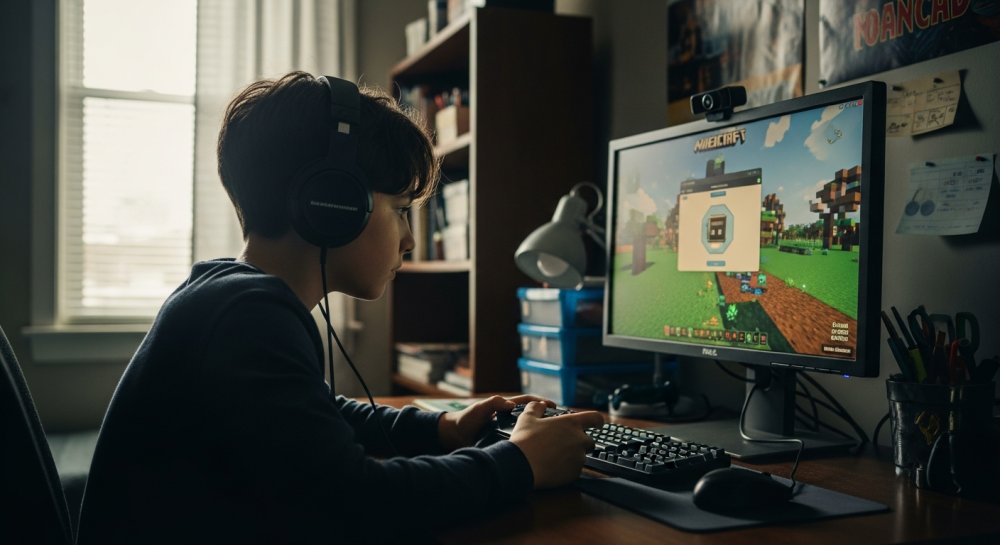
K12 has deployed Minecraft, the popular online building game, for educational purposes. The company created specialized “worlds” aligned with curriculum standards, including the Roman Empire, Jamestown, Ancient Egypt, and oceanic environments.
The contrast with traditional education is stark. Instead of reading a textbook and answering questions about Jamestown, students immerse themselves in a Jamestown world, learn the same material, and still take the same unit tests.
“We looked at the difference between the students who just read the text, answered the questions, and the students that actually went through the Minecraft world and found that those students did do better on their assessment.”
McCoy explained that students using the Minecraft spaces retained information more effectively because they had to build, solve problems, and overcome challenges. Collaboration with friends added another dimension, making the experience interactive both digitally and in the real world.
As gaming expands its role in education, career opportunities are multiplying. In 2025, the Princeton Review released rankings of top schools for game design. The lists for undergraduate and graduate programs included New York University, the University of Southern California, Drexel University, and Michigan State University, among others.
Despite growing evidence and expanding academic programs, many parents remain unaware of these opportunities. Screen time concerns persist, creating a disconnect between emerging educational methods and parental comfort levels.
McCoy acknowledged the learning curve for parents but emphasized the need to reorient rather than demonize device use. The key lies in differentiating between unstructured scrolling and engaging with games containing educational content, even when that content is cleverly hidden.
K12 is working to demonstrate both the opportunities gaming presents and the effectiveness of game-based learning. Some parents have changed their perspectives after engaging with the games themselves.
“Now we have parents that are in Minecraft, that are playing with their students. It’s like, ‘I learned so much about Jamestown, I had no clue.'”
The shift represents more than just a new teaching method — it’s a recognition that the skills needed for tomorrow’s workforce may be developed through tools that yesterday’s parents never imagined as educational. As technology reshapes every sector of American life, the question isn’t whether gaming belongs in education, but how quickly parents and educators can adapt to maximize its potential.
Americans deserve better educational tools that prepare students for real-world success.