Transportation
NTSB Reveals Critical Braking Systems Failed on Amazon Cargo Jet Before Deadly Miami Crash
Liberty Check
- Federal investigators confirm key braking systems did not deploy during Amazon cargo jet crash that killed five people at Miami International Airport
- NTSB reveals speed brakes and thrust reversers failed to activate despite wheel brakes being applied during Sunday’s deadly runway overrun
- Investigators preparing to interview pilots as questions mount over why critical safety systems did not function during emergency landing
Federal authorities revealed Tuesday that critical braking systems failed to deploy during Sunday’s catastrophic Amazon cargo jet crash at Miami International Airport, raising serious questions about what went wrong in the moments before five Americans lost their lives.
While the aircraft’s wheel brakes were applied, available data shows the speed brakes and thrust reversers — essential components for stopping large aircraft — never activated, according to the National Transportation Safety Board (NTSB).
“There was no indication in the recorded data that speed brakes or thrust reversers were deployed,” said Chihoon Shin, the NTSB investigator in charge.
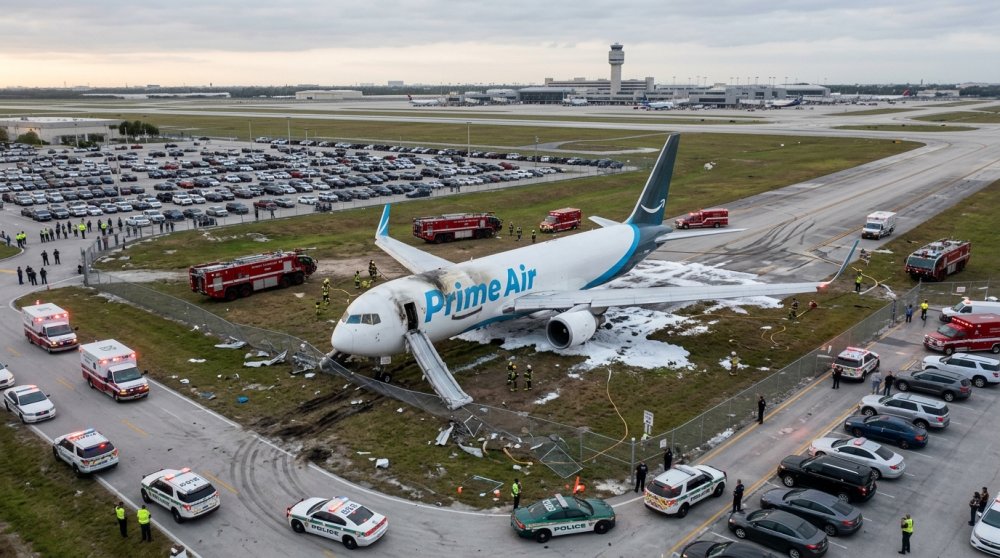
The Boeing 767 cargo jet overran the runway, plowed through the airport fence, and struck multiple vehicles before coming to rest near a parking lot. Seven victims were in a van that was crushed on airport property. The plane then traveled through the perimeter fence and struck another civilian vehicle.
Shin said investigators are preparing to interview the flight crew but declined to speculate on what should have occurred during the landing sequence.
“When we analyze the full list of parameters, we’ll have a better idea of the aircraft’s performance during this landing. Was it normal? Was it not? And what was working and what was not. So I’m not going to speculate on what should have been right now,” he said.
“What we need to do is talk to the crew and get their account to understand how they’re manipulating the controls in order to get a better understanding of the situation. That’s something that we need a complete understanding of.”
While officials did not identify the pilots involved, NTSB Chairwoman Jennifer Homendy revealed the captain was 55 years old with 7,145 flight hours, according to his latest Class 1 medical certificate dated March 31, 2026. The first officer was 37 years old with 2,655 flight hours, per his Class 1 medical certificate dated April 13, 2026.
Investigators confirmed no hazardous materials were aboard Prime Air Flight 7598. The cargo consisted mainly of contact lenses weighing 32,222 pounds, along with a flight kit.
“They did confirm there was no hazmat on board. The cargo was mainly made up of contact lenses, again weighing 32,222 pounds. And then, of course, a flight kit,” Homendy said.
At least five people were killed and another five injured in the Sunday crash. The investigation continues as families mourn and Americans demand answers about how such a preventable tragedy could occur at one of the nation’s busiest airports.
Our freedoms depend on staying vigilant.