National Security
What America Lost Forever After This Single Tragic Day
Liberty Check
- After 9/11, 72% of Americans believed the country was heading in the right direction — today’s polarization makes such unity unthinkable
- George W. Bush received over 80% approval from Democrats post-9/11; no modern president comes close to that cross-party support
- Congressional approval doubled to 84% and trust in government soared to 60% — metrics that expose how fractured our nation has become
Today marks the 25th anniversary of the September 11, 2001 attacks. The images from that day still evoke the fear Americans felt in the weeks that followed. But out of that fear came a wave of national unity and pride that we haven’t experienced since.
Looking back at the polling after 9/11 reveals how dramatically our country has changed. Our immediate instinct was to come together.
In one poll, 72% said the country was going in the right direction; just 11% said it was off on the wrong track.
The post-9/11 period was the last sustained stretch when a majority of Americans felt optimistic about the country. There were smaller rallies at the start of the Iraq War and after Saddam Hussein’s capture. But by 2004, “wrong track” had taken the lead, and we haven’t looked back since.
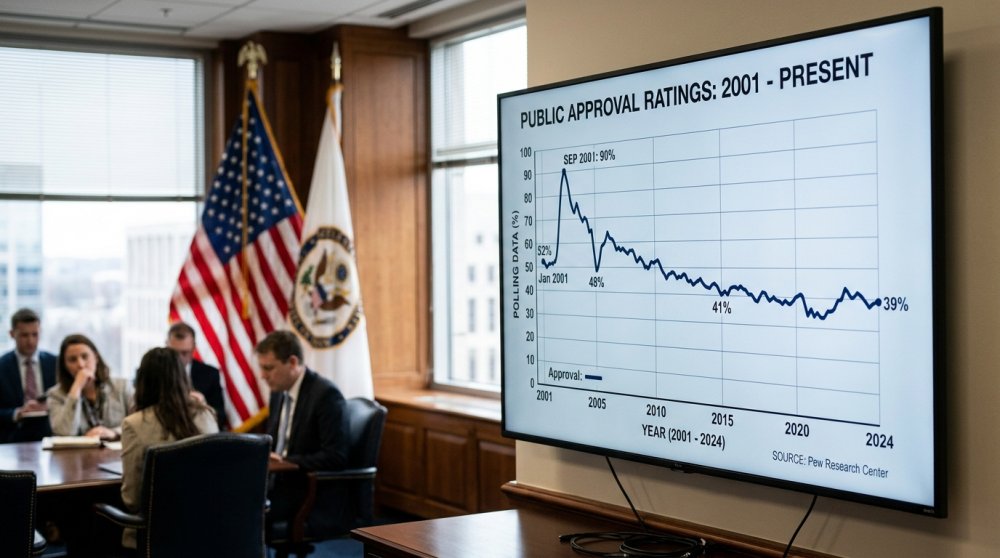
Presidential approval numbers tell an even more striking story. Americans rallied behind George W. Bush, including overwhelming majorities of Democrats. Democratic job approval for Bush reached well into the 80s in September 2001.
The conventional wisdom blames Iraq for breaking our post-9/11 unity. But the rally lasted longer than people remember. Bush’s overall approval was still above its pre-9/11 level when the Iraq War began 18 months later.
The invasion itself triggered another rally. Partisan divisions had already begun to return, but the prolonged insurgency deepened them. By Bush’s second term, we were settling into the extreme polarization that has carried through to today.
Consider where Bush’s job approval stood among Democrats before 9/11, during normal times: nearly 30% — roughly where it returned before the Iraq War, then briefly spiked to close to 50%.
Those out-party approval numbers would be unheard of for a president of any party today.
The 2000 election gave us the modern partisan alignment that 2016 ratified. But 9/11 interrupted it. The unity that followed was born of something nobody would have wished for.
We haven’t seen unity on that scale in a national emergency since.
More jarring still are the figures for Congress, trust in government, the political parties, and the press. In the days before the attacks, congressional approval stood at 42%. A month later, it had doubled to 84%.
In January 2001, just 31% of Americans trusted the federal government to do what was right. In October 2001, 60% did.
Even before the attacks, both parties were viewed more positively than negatively. Both improved afterward, with Republicans holding a 56-22 favorability rating and Democrats 48-23 in December 2001.
Even the media benefited. The share saying news organizations generally got their facts straight rose from 35% in early September to 46% in November. The share saying that news organizations stood up for America rose from 43% to 69%.
The share viewing them as protecting democracy rose from 46% to 60%.
Thankfully, America hasn’t faced an attack like 9/11 in the quarter century since. Amid today’s challenges, it’s worth remembering that the worst fears about what comes next don’t always come to pass.
But we have faced major national emergencies since — Covid-19 being the most prominent — and the public reaction was nowhere close to what we saw after 9/11. Donald Trump’s overall approval went up a few points in March 2020 and one poll recorded 60% approval of Trump’s handling of coronavirus, including 27% of Democrats.
But by the summer of 2020, 77% of Americans thought the country was more divided than before the outbreak.
Other world leaders enjoyed longer rallies during the pandemic, but those, too, faded as lockdowns dragged on and inflation took hold. The contrast with Bush is striking: 9/11 arguably guaranteed his re-election, even as Iraq grew more difficult.
Nor has the recent upsurge in political violence produced anything resembling that broader sense of unity. The assassination attempt on Donald Trump and the killing of Charlie Kirk a year ago didn’t produce any lasting change in public opinion.
Perhaps some of this comes down to the sheer scale of 9/11, the first mass-casualty attack on U.S. soil since Pearl Harbor. But it also happened in a country that was already more trusting and optimistic than the one we live in today.
If the same thing happened today, the grief would be just as great, but the sense of shared purpose and unity nowhere close.
The numbers don’t lie: we’ve lost something fundamental as a nation. The question is whether we can ever find our way back to that spirit of unity without another tragedy forcing our hand.
The Constitution must be defended.