News
What This Patriotic Woman Risked Her Life To Create — And Why The Left Keeps Trying To Erase Her
Liberty Check
- Betsy Ross, an ordinary Philadelphia seamstress, risked execution by British authorities to create America’s first flag in 1776 — an act of treason that helped birth our nation
- The original 13-star design symbolized equality among the colonies, sewn in secret by hand over just one week while America fought for independence
- Ross’s story proves America wasn’t built by elites alone — but by everyday patriots willing to sacrifice everything for freedom
As America celebrates its 250th birthday, one name stands out among the Revolutionary heroes: Betsy Ross, a 24-year-old upholsterer who sewed what many believe was the very first American flag in the summer of 1776. Her story isn’t just about stitching fabric — it’s about ordinary courage in the face of tyranny.
According to Lisa Acker Moulter, director of the Betsy Ross House in Philadelphia, Ross was approached by members of a flag committee that included George Washington himself. The request was simple but dangerous: create a symbol for a nation not yet born.
“She said she’d never made one before, but she would certainly try,” Moulter explained.
“She did suggest one change though, the flag that they showed her that was drawn on a piece of paper had six-pointed stars and she recommended five-pointed stars because they were easier to make. She had a method that she had learned as a child to fold a piece of cloth or paper and she cut a perfect five-pointed star with just one snip of her scissors.”
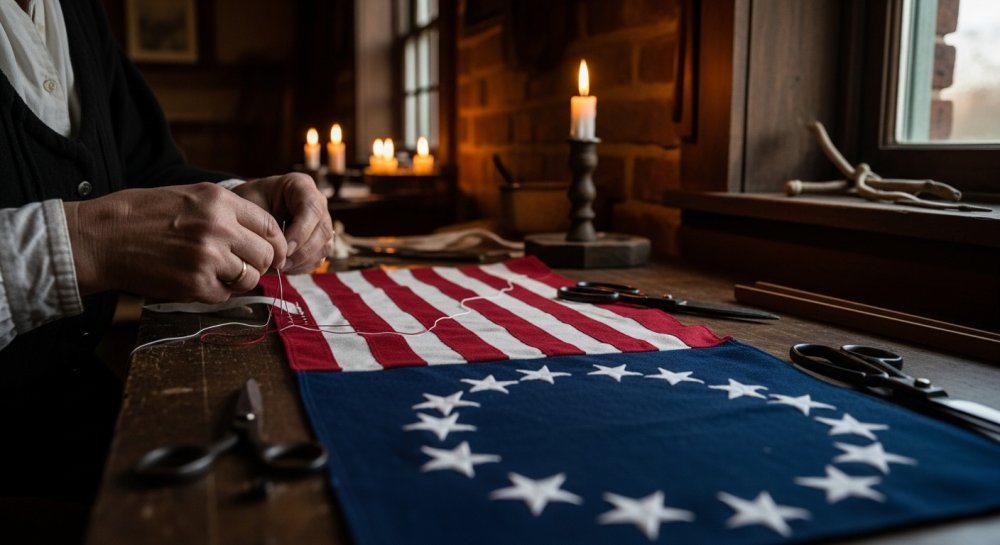
Ross worked in secrecy, sewing the flag by hand at night — likely in her home rather than in her upholstery shop. She completed the entire flag in about a week, all while the colonies remained under British rule.
This wasn’t just a craft project. It was an act of defiance that could have cost her everything.
“You have to remember that we were a British colony at the time, so making the flag would have been considered an act of treason,” Moulter said.
“If she had been caught by the British or loyalists, she could have been at the very least imprisoned or possibly even executed.”
The original design featured 13 stripes representing the colonies and 13 stars arranged in a circle to symbolize equality among them. On June 14, 1777, the Continental Congress officially adopted it as the nation’s first flag — a date we now celebrate as Flag Day.
But Betsy Ross’s story represents something deeper than one woman’s handiwork. It’s a reminder that America’s founding wasn’t the work of a few elite men alone — it was built by everyday patriots willing to risk everything for freedom.
“It shows that ordinary people can contribute important things to this country as well,” Moulter said.
“You know, this country wasn’t just founded by wealthy, powerful white men, the Founding Fathers. It was women, it was free and enslaved people, it was new immigrants, all of them contributed to the founding of this nation. And that’s represented through that first flag.”
In its early years, the flag served primarily as a military symbol — flown on battlefields, forts, and ships. It wasn’t until the Civil War that Americans began displaying it widely as a symbol of national unity and pride.
“They weren’t a symbol of our national identity as they are today. That didn’t happen until the Civil War,” Moulter explained.
“So from the Civil War until today, that’s when you started seeing flags flown over schools, flown on government buildings, flown on houses. So the flag has changed over time. It’s become much more powerful and meaningful to people.”
The flag itself has evolved alongside the nation. The first major update came in 1795 with the addition of two stars for Vermont and Kentucky. The most recent change came in 1960 after Hawaii became the 50th state.
Today, as Philadelphia marks America’s 250th anniversary, the Betsy Ross House continues to share her story with visitors — a reminder that freedom requires sacrifice, and that ordinary Americans have always been the backbone of this great nation.
Our freedoms depend on staying vigilant.