Foreign Policy
Trump Faces Biggest Xi Test Yet — China’s AI Ambitions Threaten American Dominance
Liberty Check
- China openly declares AI mastery as ‘the front line’ of international competition — this isn’t rhetoric, it’s Beijing’s strategic roadmap for global dominance
- Trump’s Beijing summit involves Taiwan, semiconductors, Iran, and the future of American technological leadership in what increasingly resembles a new Cold War
- Beijing is flooding global markets with surveillance tech and computing power while systematically stealing U.S. AI systems through industrial-scale fraud
When Chinese President Xi Jinping publicly declared that mastery of artificial intelligence is “the front line and main battlefield of international competition,” he was not indulging in political theater. He was announcing the strategic framework now guiding Beijing’s economic, military and technological ambitions.
After 24 years in uniform and another two-plus decades studying America’s adversaries — from the Pentagon to a think tank to writing 14 books on geopolitical threats — seasoned defense analysts have learned to take authoritarian leaders seriously when they openly declare their intentions.
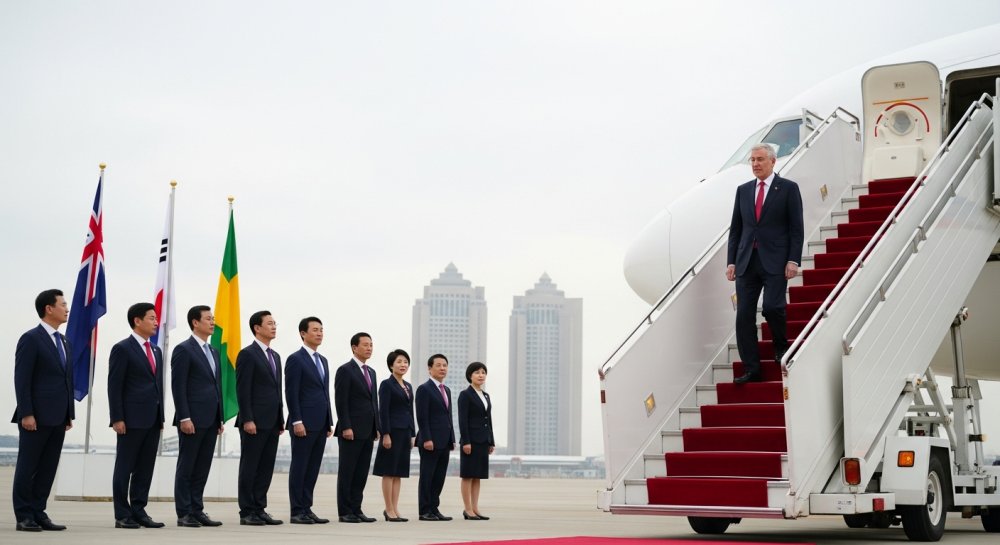
As President Donald Trump arrives in Beijing on May 14 for his first visit to China since 2017, the central question is whether Washington fully understands the scale of the contest now unfolding. This is not a routine summit centered on trade disputes or diplomatic optics.
According to senior officials, discussions will involve Iran, Taiwan, semiconductors, rare earth minerals, tariffs, computing infrastructure and military stability. No Trump-Xi meeting in recent memory has carried this level of geopolitical risk.
The Middle East remains in open conflict following the Iran war. That conflict has forced the Strait of Hormuz closure, triggering the most severe global energy shock in years and giving Beijing unusual leverage over economies desperate for stable supply chains.
Taiwan sits under mounting Chinese military pressure. Meanwhile, Washington and Beijing are accelerating toward what increasingly resembles a new Cold War — not centered on nuclear weapons, but on chips, data, automated systems, infrastructure and digital control.
Beneath the ceremonial handshakes lies something far larger than diplomacy. Trump and Xi are not merely negotiating trade balances. They are negotiating over who shapes the international order for the next generation.
For years, many American policymakers viewed China primarily through an economic lens. That era is over.
Beijing now openly links computing power, industrial policy, military modernization, surveillance systems and digital infrastructure into a unified strategy of national power. Recent analysis describes this struggle as “not a war of tanks and missiles alone, but of algorithms, data, and digital power.”
Recent developments confirm that China is moving faster than many in Washington appreciate. A major analysis warned that Beijing is preparing to flood the world with exports of its computing technology after becoming increasingly self-sufficient in chips, infrastructure and open-source machine-learning systems.
Huawei’s newest Ascend processors reportedly approach the performance of advanced Nvidia systems, while Chinese firms such as DeepSeek and Alibaba aggressively expand deployment across Asia, Africa and the Middle East. What once looked like a technology gap is narrowing into a strategic race.
The theft dimension is no longer theoretical. On April 23, White House Science Advisor Michael Kratsios formally accused China of conducting “industrial-scale campaigns to distil U.S. frontier AI systems” — leveraging tens of thousands of proxy accounts and jailbreaking techniques to extract capabilities from American models and train cheaper Chinese versions.
Anthropic has documented that three Chinese laboratories generated over 16 million fraudulent exchanges with its systems to accomplish exactly that.
Washington and Beijing are also exploring possible guardrails and crisis communications channels, recognizing that neither side benefits from uncontrolled escalation involving autonomous systems and cyber operations. When rival powers negotiate emergency protocols for machine-directed conflict, the world has entered a new era.
The danger extends beyond the technology race itself.
China increasingly fuses automated surveillance, industrial policy, machine-learning infrastructure and state power into a digitally enforced authoritarian system. According to Huawei, its “Safe City” platforms have been deployed in hundreds of cities worldwide.
Governments across Africa, Southeast Asia and the Middle East now rely on Chinese surveillance infrastructure. China is not merely exporting cameras and software. It is exporting a governance philosophy built on control rather than consent.
In many cases, nations adopting Chinese systems also inherit Chinese technical standards, Chinese data ecosystems and Chinese assumptions about censorship, monitoring and centralized authority. That matters because the emerging contest between Washington and Beijing is not simply economic. It is ideological.
Taiwan may be the summit’s most combustible issue.
Reports indicate that Trump intends to discuss Taiwan arms sales directly with Xi, acknowledging publicly that Beijing wants those sales reduced. Xi’s government has made clear it will never tolerate Taiwanese independence, and any ambiguity from Washington would embolden further aggression. Any concession there would be a grave mistake.
Taiwan produces more than 90% of the world’s most advanced semiconductors. Losing reliable access to that manufacturing capacity would severely damage American defense production, communications systems and advanced computing industries.
But Taiwan is about more than chips. The island sits at the center of Indo-Pacific maritime security and represents a test of American credibility with allies from Tokyo to Manila. Softening support for Taiwan in exchange for temporary diplomatic concessions elsewhere would not produce peace. It would invite further escalation.
Iran will also weigh heavily on the summit.
China remains one of the largest buyers of Iranian oil, helping sustain Tehran economically despite Western sanctions. The Strait of Hormuz closure has sharpened that leverage: China has weathered the energy shock better than most, giving Xi unusual geopolitical confidence at the negotiating table.
Trump must not trade long-term American strategic interests for vague Chinese promises regarding Iran. Beijing may offer diplomatic assistance or pressure on Tehran, but any arrangement that strengthens China’s geopolitical position while leaving Iran strategically intact would weaken America’s long-term standing across the Middle East.
Xi comes to the summit seeking economic relief, tariff stability and strategic breathing room. Trump arrives facing the challenge of preserving American leverage without triggering uncontrolled escalation.
Both leaders likely want stability. Neither side benefits from direct confrontation between the world’s two largest powers. But history teaches that stability without strength rarely lasts.
“Unless the Lord watches over the city, the watchman stays awake in vain.”
America’s watchmen cannot afford complacency.
This summit is not merely about tariffs, Taiwan, or temporary diplomatic agreements. It is a reckoning over who governs the technologies, infrastructure and strategic systems that will shape the 21st century. Russian President Vladimir Putin is expected in Beijing just days after Trump’s departure — a reminder that the alliances forming around this contest will define the global balance of power for a generation.
America’s allies in Tokyo, Seoul, Canberra, London and beyond are watching carefully.
The question is no longer whether the United States and China are competing for global influence. The question is whether America still possesses the clarity, resolve, and strategic patience required to prevail in the defining geopolitical contest of our age.
The Constitution must be defended.