Education
HBCU President Sparks Firestorm With Bold Workforce Prep Mandate
Liberty Check
- Retired Air Force Major General introduces professional dress standards at historic Alabama HBCU to prepare students for competitive workforce
- New policy requires business attire, bans casual headwear and revealing clothing in academic settings while providing resources for students who need professional wardrobe assistance
- Alumni defend standards as critical career preparation despite online critics claiming cultural targeting
A retired U.S. Air Force Major General is making waves at one of America’s most prestigious Historically Black Colleges and Universities with a no-nonsense approach to preparing students for real-world success.
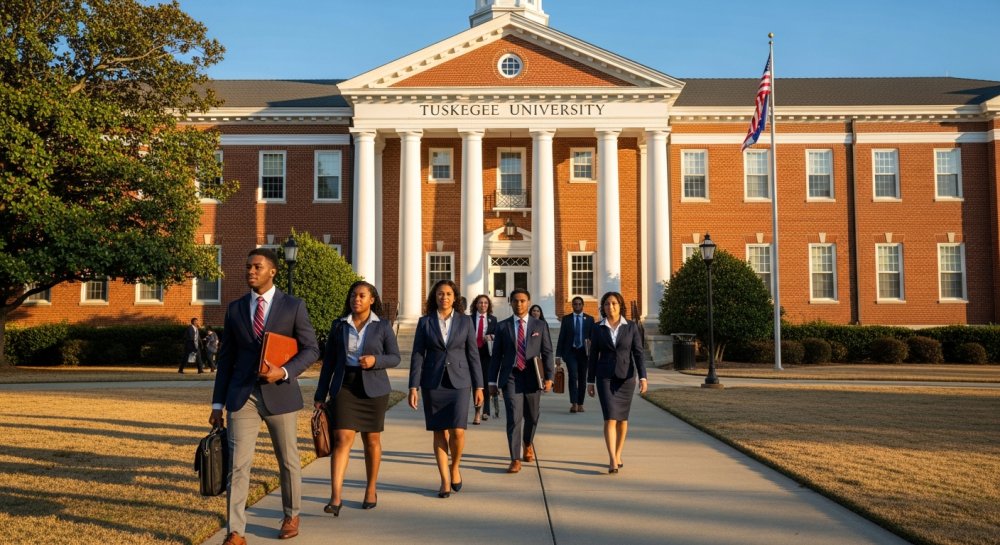
Dr. Mark Brown, president and CEO of Tuskegee University in Alabama, has implemented a comprehensive dress code and professional standards policy that’s drawing both praise from alumni and criticism from social media activists. The new requirements mandate that students arrive on campus with business suits and proper shoes, while prohibiting casual attire like du-rags, bonnets, bedroom shoes, and revealing clothing in classrooms and cafeterias.
“The university has developed a new policy for student attire on campus, classroom attendance, and cell phone use in classrooms,” Brown wrote in a message to students. “Tuskegee students now have a dress code for public and professional places.”
“The Student Handbook requires students to arrive on campus with a business suit and proper shoes for a business meeting,” the message continued. “Students are prohibited from wearing revealing clothing in class, to the cafeteria or in official settings like Convocation. They are also not able to wear bedroom shoes, bonnets, or du-rags to class or the cafeteria.”
Brown, who assumed leadership two years ago, made clear the purpose behind the policy goes far beyond arbitrary rules.
“The goal here is not meant to restrict you from enjoying the Tuskegee Experience, but to prepare you with a solid foundation for the workforce you will enter once you leave Tuskegee,” Brown wrote. “Employers are less forgiving and too often presentation may overrule stellar preparation.”
The comprehensive guidance restricts headwear including hats, bonnets, head scarves, caps, hoods, du-rags, bandanas, and sunglasses in classrooms and cafeterias, with exceptions for documented medical, religious, or cultural purposes. The policy also addresses revealing clothing, requiring that pants, skirts, dresses, and shorts be worn appropriately for a professional educational environment.
“Clothing should fit properly and not expose undergarments or other private areas,” the dress code policy states. “Excessively short shorts, swimsuit bottoms, body suits, sleeveless undershirts, and similar casual garments are not appropriate for professional classroom settings.”
The policy further prohibits t-shirts worn as dresses and sagging pants, requiring that baggy or loose-fitting pants be worn with properly fitted belts.
Faculty members will have authority to enforce the standards, though specific penalties weren’t detailed in the announcement. The policy comes as Tuskegee expects its highest new-student enrollment in 32 years.
While some online critics have attacked the restrictions as “respectability politics” that unfairly target clothing associated with Black culture, many alumni are strongly defending the university’s approach.
Tuskegee graduate Gwen McKinney told NBC4 Washington that the policy was “a breath of fresh air,” adding there is “a time and place and a setting for every kind of dress.”
“A critical part of being ready for and confident in business environments is being appropriately dressed,” said Walter P. Cooper, Sr., Director of the Career Education and Leadership Development Center.
“We know that every workplace doesn’t require business attire – our center includes business casual and casual attire, too – but as our students prepare to enter those workplace scenarios that do, it is important that access to the right wardrobe is not a barrier.”
For students who may lack proper professional attire, the university has established The Golden Tigers Community Closet to help outfit those in need—ensuring economic circumstances don’t prevent students from meeting the new standards.
“One of the key pillars of Tuskegee’s Renaissance Era is our focus on career readiness for our students,” Brown said. “Academically, we are equipping our students to stand shoulder to shoulder with any candidates competing for roles in the global economy. The Golden Tigers Community Closet is an important way to ensure that every student can also feel confidently dressed when they step into those spaces.”
The dress code is part of a broader set of classroom and career-readiness reforms. Cell phone use will also be prohibited in class unless specifically authorized by instructors.
“Unless directed by the professor, students are no longer allowed to use their cell phones while in class,” Brown’s message stated. “They should be turned off to eliminate any distraction from the instructor’s lesson.”
Thonnia Lee, VP of Strategic Communications for Tuskegee University, confirmed the details of the president’s message and dress code policy but declined additional comment.
Preparing students for success in the real world should never be controversial—it’s what education is supposed to do.