Entertainment
Ancient Mystery Solved: Stunning Discovery Near Colosseum Reveals Rome’s Hidden Past
Liberty Check
- Archaeologists uncover rare 2,000-year-old structure near Rome’s Colosseum that may rewrite our understanding of ancient Roman military infrastructure
- Ancient mosaic matches firefighting barracks design, suggesting the building housed Rome’s elite Vigiles force who maintained order and fought fires
- Discovery highlights importance of preserving Western civilization’s foundational heritage and the architectural genius of ancient Rome
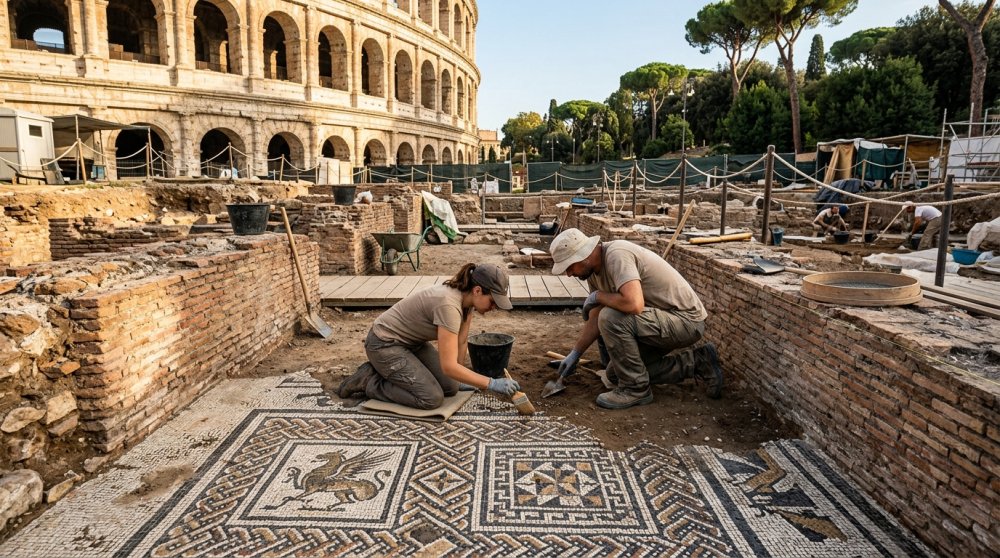
Archaeologists working near Rome’s iconic Colosseum have uncovered what they believe to be a nearly 2,000-year-old firehouse, offering a rare glimpse into the sophisticated public safety systems of ancient Rome. The discovery challenges our understanding of how the eternal city protected its citizens and property during the height of the Roman Empire.
The building, dating to the second century A.D., was found in Villa Celimontana park on Caelian Hill, one of Rome’s legendary seven hills. Villa Celimontana itself dates to the 16th century, when it served as a noble residence, but the excavation beneath has revealed far older secrets.
Rome’s archaeological superintendency, part of Italy’s Ministry of Culture, announced the discovery after researchers fully uncovered five of the building’s eight rooms. The rooms contain intricate mosaics and remnants of painted decorations that speak to the craftsmanship and attention to detail characteristic of Roman architecture.
Officials believe the structure may have been part of the barracks for the Fifth Cohort of the Vigiles, ancient Rome’s dedicated firefighting force. The Vigiles were far more than firefighters — they also maintained public order during nighttime hours, functioning as both emergency responders and law enforcement in the ancient metropolis.
The key evidence linking the building to the Vigiles is a distinctive mosaic pattern discovered at the site. This mosaic closely resembles one previously found in confirmed firefighters’ barracks in Ostia, ancient Rome’s port city, suggesting a standardized design for these critical public safety facilities.
<"If this hypothesis is confirmed, the discovery would help reassess the extent of one of the most important military complexes of imperial Rome," officials said in a statement.
The Vigiles barracks strategically used water from nearby aqueducts, Rome’s engineering marvel that brought fresh water into the city. This positioning allowed rapid response to fires, which posed a constant threat in the densely populated ancient city where buildings were often constructed with flammable materials.
Excavation photos show the exposed walls and sections of the ancient building, revealing the remarkable preservation of structures that have endured nearly two millennia beneath Rome’s soil. Other images display fragments of the intricate mosaic work that decorated the floors.
However, archaeologists acknowledge an alternative possibility: the structure could have been a private residence, known as a domus, similar to other wealthy homes discovered on Caelian Hill. The elaborate decorations and artistic details would support this hypothesis, as Roman elites competed to display their wealth and cultural sophistication through ornate home designs.
“Only a thorough study of the excavation materials and the structures exposed will provide further information on the newly discovered structure,” the superintendency stated, emphasizing the careful scholarly analysis required to definitively identify the building’s original purpose.
This discovery joins a remarkable series of ancient Roman finds emerging across Italy. Archaeologists recently uncovered an entire ancient city along the famed Appian Way, complete with a forum and theater dating back more than 2,000 years.
Earlier this summer, officials announced another major discovery near the Colosseum itself — the remains of an ancient Roman villa found beneath a high school gymnasium, demonstrating that Rome’s archaeological treasures continue to hide in plain sight beneath modern structures.
These discoveries underscore the enduring legacy of Western civilization’s Roman foundations. The engineering genius, organizational sophistication, and civic commitment displayed in structures like the Vigiles barracks remind us of the advanced society that formed the bedrock of European and American governmental systems.
Our freedoms depend on staying vigilant.